The hottest sustainability trends to watch

As we step into a new year, sustainability is no longer just a corporate buzzword—it’s a defining factor in business resilience, innovation, and long-term success. From AI-driven solutions to supply chain transparency, companies that stay ahead of these shifts will be the ones leading the transition to a more sustainable economy. So here is a roundup of the key trends shaping sustainability in 2025 and beyond.

1. AI is Supercharging Sustainability

Artificial intelligence (AI) is rapidly transforming the sustainability landscape. From optimizing energy use in buildings to predicting supply chain disruptions, AI is helping companies make smarter, more efficient decisions. In conservation, AI-powered monitoring tools are tracking deforestation and biodiversity loss in real time. Meanwhile, AI-driven data analytics are enhancing sustainability reporting, making it easier for businesses to comply with evolving regulations. However, as AI adoption grows, so does the need for responsible energy use—after all, training large AI models requires significant resources. Businesses will need to ensure that their digital sustainability efforts don’t come at an environmental cost.

2. Circularity is No Longer Optional

The shift from a linear “take-make-waste” economy to circular business models is accelerating. In 2025, companies will be held to even higher standards for reducing waste, reusing materials, and designing products for longevity. Brands that embrace circularity—not just through recycling but through innovative business models like rental, resale, and repair—will gain a competitive edge. Consumers and regulators alike are demanding transparency around materials and product lifecycles, making circular economy strategies a necessity rather than a nice-to-have.

3. Stricter Regulations Are Raising the Bar

Sustainability reporting and compliance are getting tougher. The European Union’s Corporate Sustainability Reporting Directive (CSRD) is now in full force, requiring companies to disclose detailed environmental and social impact data. Meanwhile, other regions are tightening rules on carbon disclosure, supply chain due diligence, and ESG claims. The days of vague sustainability promises are over—companies must now provide quantifiable proof of their commitments. Those that get ahead of compliance rather than scrambling to react will build trust and avoid reputational risks.

There is no business to be done on a dead planet.
David Brower, Prominent environmentalist and Founder of Friends of the Earth

4. Biodiversity is a Boardroom Priority

Biodiversity loss has emerged as a major business risk, and 2025 will see an increasing number of companies integrating nature protection into their sustainability strategies. From deforestation-free supply chains to investments in ecosystem restoration, businesses are recognizing that natural capital is just as critical as financial capital. Governments and investors are also pushing for action, with biodiversity-related financial disclosures gaining traction. Brands that fail to address their impact on nature may soon find themselves facing regulatory scrutiny or consumer backlash. Our foundation Habitats is here to guide you on that journey.

5. Supply Chain Transparency is Non-Negotiable

From fashion to food, supply chain due diligence is becoming a legal requirement rather than a voluntary commitment. Consumers and regulators want to know where materials come from, how workers are treated, and whether production processes align with environmental goals. The digital product passport will become a crucial component. Advances in blockchain and digital tracking systems are helping companies increase visibility, but transparency isn’t just about technology—it requires real accountability. Brands that proactively disclose their sourcing and labor practices will be better positioned to navigate new regulations and build trust with conscious consumers.

The Bottom Line

2025 is the year where sustainability moves from aspiration to obligation. Companies that embed sustainability into their core strategies—not just as an add-on but as a fundamental business principle—will not only meet regulatory demands but also drive innovation, resilience, and long-term success.

Is your business ready?

It is time to reduce your negative impact, and most importantly make a positive change. We are here to help you across these five trends.

Understanding double materiality and complying with CSRd

It is becoming increasingly important for organizations to showcase and report their commitment to sustainability. The current landscape on how to evaluate sustainability performance can be hard to navigate due to a lack of standardized metrics and methodologies. Where to start? Which framework is best to choose? And what about double materiality?


For companies based in the European Union, the call for clear CSR reporting standards has finally been answered. The Corporate Social Responsibility Directive (CSRd) is here for good and will guide companies along their sustainability journey.

What is CSRd? 

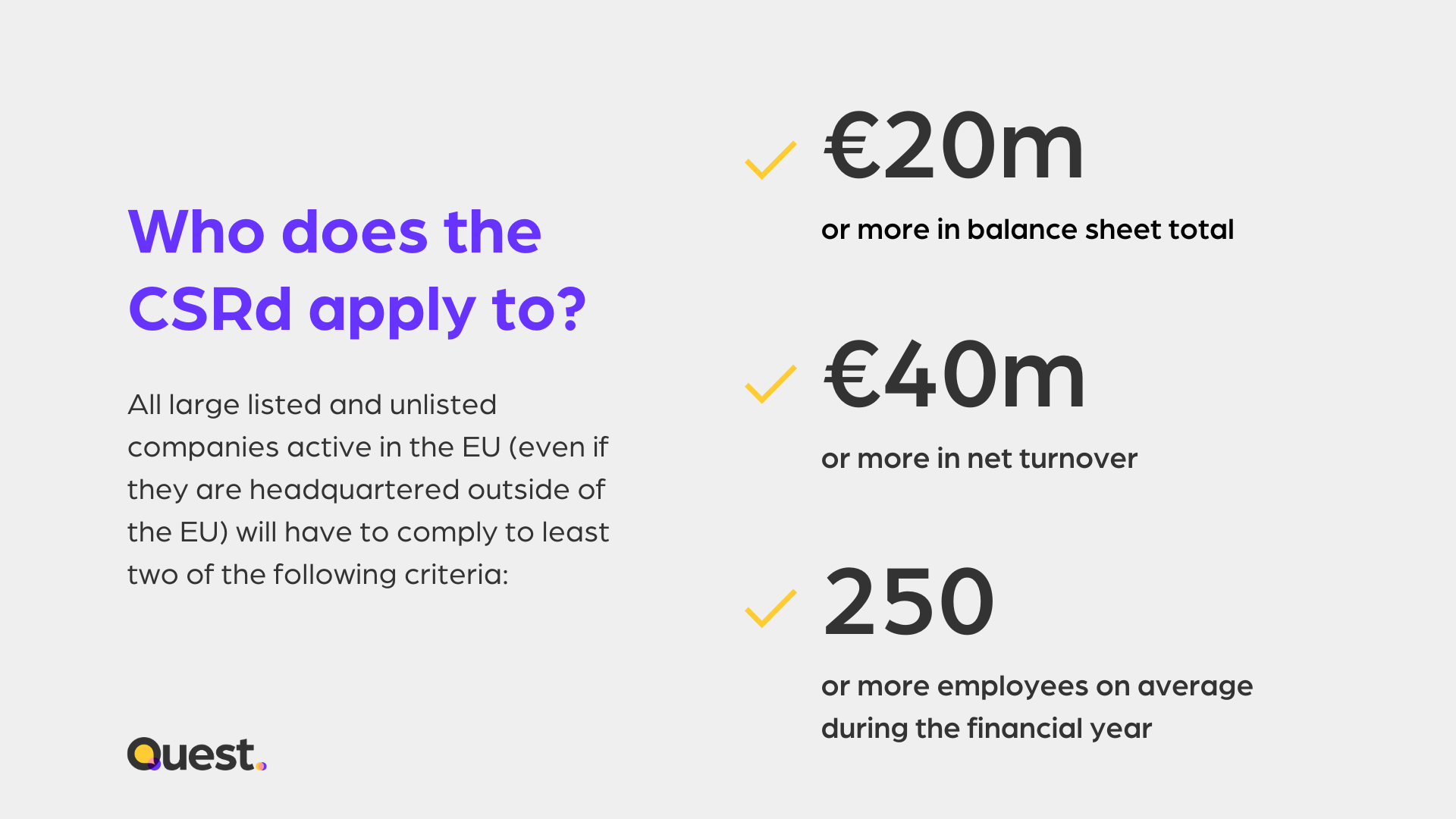
The CSRd came into force on January 5, 2023, and establishes a uniform framework for the reporting of non-financial data for companies based and operating in the European Union. It replaces and builds on the existing Non-Financial Reporting Directive (NFRD) and now puts impact reporting on the same level as financial reporting. Its aim is to advance the scope and quality of sustainability reporting by increasing transparency through comparable non-financial information.

How is it done? 

The twelve European Sustainability Reporting Standards (ESRS) within the CSRd are here to ensure that in-scope companies provide reliable, comparable, and relevant sustainability data. They are structured around four thematic reporting areas (strategy, risk and opportunities, metrics and targets, and governance) that represent core elements of how organizations operate. The standards will delve into general requirements and disclosures, expand on ESG topics such as pollution and affected communities, for example, and notably also set out sector-specific information that will be announced later this year (stay tuned by signing up for our newsletter!). More importantly than ever, they will also delve into double materiality.

What about double materiality?

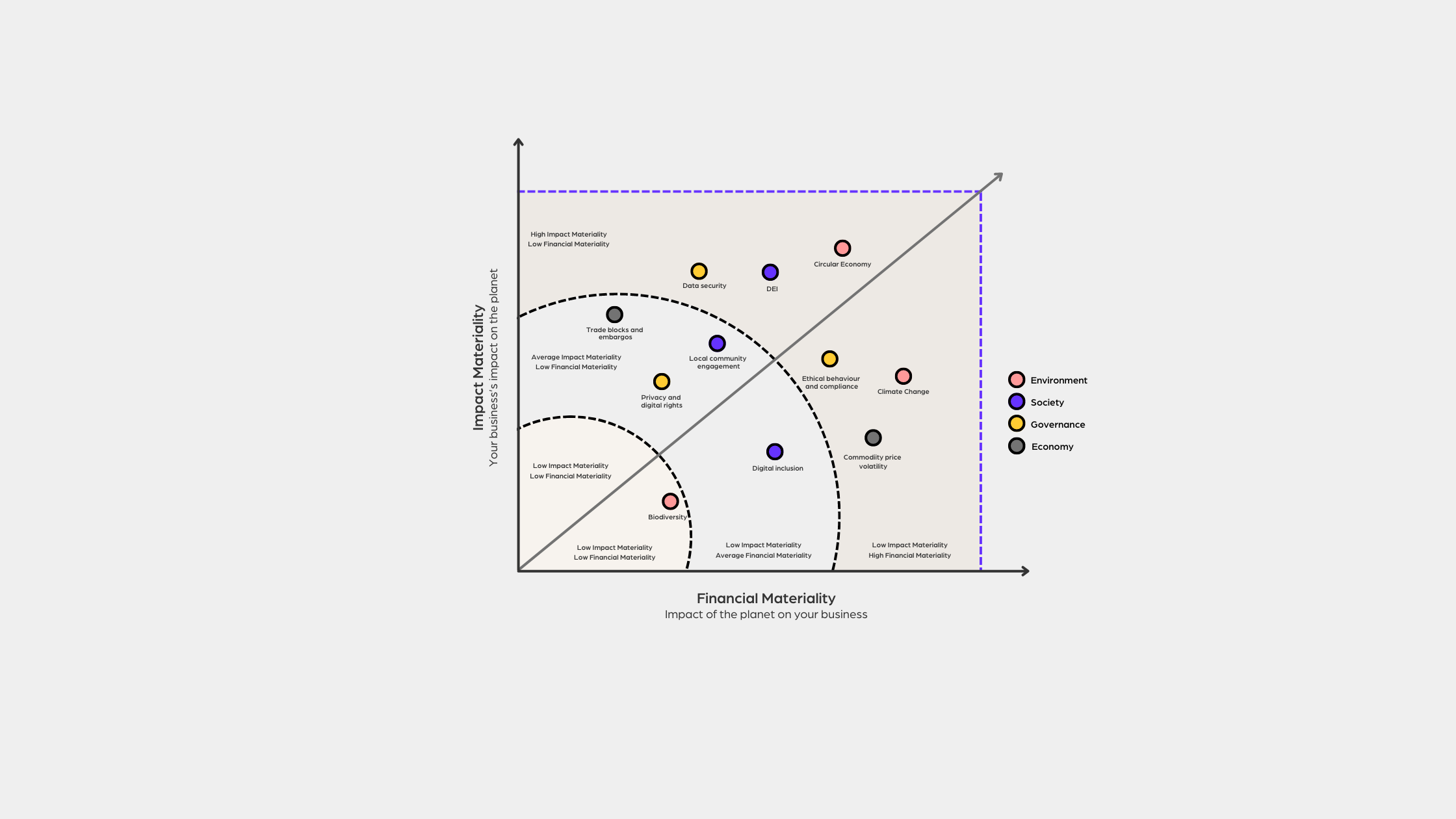
All in all, a materiality assessment refers to identifying the issues that matter most to an organization and determining how important they are. One key factor within the ESRS is adopting the principle of double materiality. It is a holistic approach that prevents one-sided reporting and instead looks at both financial and non-financial impacts. Materiality acknowledges sustainability factors that may affect the company in terms of financial risks and opportunities. It is, therefore, an outside-in perspective that analyzes the impact of the world on a company. Double materiality, on the other hand, includes an inside-out perspective in which one identifies and analyzes the impact that company activities have on people and the planet.

CSRd disclosures will be made publicly available and audited for accuracy and completeness by a third party in a process that can take a significant amount of time. Tailoring a compelling impact report is therefore becoming more important than ever. It is already clear that preparing early for reporting will unearth a range of new opportunities and add a tremendous amount of value to organizations, whether it is to attract new investors that are increasingly prioritizing sustainability to make financial decisions, to set yourself apart from rival businesses with a competitive advantage, or to increase trust and engagement both internally and externally by demonstrating your commitment. Getting started early will allow you to transition to new legislation seamlessly and position your organization ahead of the curve.

How can we help?

From materiality assessment to impact strategy, from B Corp to CSRd compliance, to impact reporting, Quest is here to consult and advise you on the way. Feel free to book a call with us if you would like to have further information on this.

Price parity in sustainability: key challenge or unfair battle?

When you try to scale a sustainable product, you encounter hundreds of challenges. One of the key challenges we see at Quest is how to price a sustainable product. There is no secret that sustainable options tend to be more expensive. In our opinion, that doesn’t mean that they are too expensive though, but rather that conventional choices are simply too cheap as they fail to take into account both environmental and social costs.


And yet we see so many interesting organizations failing to bring their sustainable options to market in the long-term because they can’t reach economies of scale fast enough to get to that point of price parity. So is reaching price parity really the game changer for sustainable products?

Why is price parity so important?

We’re living in a tough economic landscape right now, characterized by wars and rising inflation. The cost of living is going up and in most regions of the world, people’s salaries don’t increase fast enough to cover that gap.

Research has shown that when the cost of living increases, people will prioritize saving money over making ethical decisions. In a 2021 survey conducted by Proveg, 40% of consumers stated that a higher cost of living has led them to eat less plant-based food.

So now, more than ever, the price of your product determines how big the barrier is for people to start trying or buying it. Affordability = accessibility.

Solar panels lead the way

One sustainable product is a key example: solar panels. Solar panels were once very expensive, but now they’ve reached economies of scale (definitely not always in the right way, but that’s another discussion) and investing in solar panels delivers a relatively fast ROI. While looking at energy-storing batteries, the ROI is still less attractive so people are inclined to wait.

Is it a fair battle?

Not at all. We know the cost of living is already hurting a lot of people and yet we have to acknowledge that a lot of the products we buy are simply priced way too cheaply. Why? Because typically a seller can only reach that price level by not paying the people in their supply chain enough, or by not taking into account the social and environmental cost of their product. The True Price Foundation is an interesting organization that aims to change this.

A farmer who’s not using pesticides to boost vegetable growth has to spend money on a verifying body to confirm that. And then all bio vegetables have to be wrapped up in plastics to make sure no ‘contamination’ is happening in the supermarket. A farmer who uses pesticides doesn’t have that cost and can, hence, offer its product at a lower price or take more margin. Why don’t we turn that around? 

What to do when you haven’t reached price parity yet?

Let’s look at your closet: how many items do you have in there that you really value? Be sincere . Chances are that there won’t be too many. We need to change that. We don’t need more items, but we need to value the stuff we own again.

We have to be honest: price will always be a determining factor for consumers, but if there’s one key that can help tip the scale it is transparency and traceability mixed with a good portion of storytelling, making often complex information as accessible as possible.

Want more information on nudging sustainable behavior?

Nudging is a strategy that subtly guides people towards sustainable behaviors without limiting their choices – making them easy, affordable, accessible, and engaging. 

How will people feel when they scan the QR code on their 3-EUR shirt and see where and how it’s been produced? The Corporate Sustainability Due Diligence Directive and digital product passports are coming and they will prove to be a gamechanger.

Let’s step away from textile and look into food: how much crap do we eat that harms our health? If we talk about price parity, isn’t bad health also a price you pay? And what if your product has a proven(!) positive effect on someone’s health: how much is that worth to someone?

It’s time to switch the narrative and make radical collaboration and transparency the norm. Who’s leading the way?

Quest is expanding its presence in Europe with a new office in Luxembourg, strengthening its role as a partner in sustainability consulting and biodiversity/nature strategy. By expanding to one of Europe’s leading hubs for sustainable finance and corporate responsibility, Quest is set to help organizations navigate the future of sustainability, biodiversity, and impact-driven growth.

Luxembourg text in front of office buildings

Quest is expanding its presence in Europe with a new office in Luxembourg, strengthening its role as a partner in sustainability consulting and biodiversity/nature strategy. By expanding to one of Europe’s leading hubs for sustainable finance and corporate responsibility, Quest is now more set than ever to help organizations navigate the future of sustainability, biodiversity, and impact-driven growth.

Why Luxembourg?

Luxembourg has rapidly positioned itself as a hub for sustainable finance and corporate sustainability leadership. With strong networks in finance, business, and policy, the country offers a unique environment for pioneering initiatives that align economic growth with biodiversity protection.

Michael Boschmans
"Luxembourg is at the crossroads of finance, sustainability, and innovation. It’s the perfect place to accelerate our mission: supporting businesses and investors to integrate biodiversity and nature strategies into their operations. With Raf leading the way, we’re building a bridge between strategy, action, and measurable impact."
Michael Boschmans, Founder Quest

Raf Stassen brings strong biodiversity and NGO expertise

Heading the new office is Raf Stassen, a seasoned leader in biodiversity and NGO development. Raf is not only a co-founder of Habitats (the nonprofit co-founded by Quest dedicated to nature conservation and restoration) but also brings extensive experience from senior roles at family funds and NGOs including Broederlijk Delen and Fundacion Jocotoco (Ecuador). His expertise in both creating biodiversity strategies and organizational development for NGOs makes him the perfect fit to guide Quest’s next chapter in Luxembourg.

With Raf, we also integrate Biota, another company he co-founded focusing on ecological studies and biodiversity assessments, into our impact-driven ecosystem.

Raf STassen

Off to a strong start

Quest Luxembourg is already working on projects that reflect its mission and ambition:

  • Partnering with IMS Luxembourg to co-develop biodiversity strategies for businesses.
  • Launching the Finance for Biodiversity Taskforce with partners including Innpact, Graine De Vie and Rio Impact, to mobilize the financial sector towards nature-positive investments.

These initiatives signal Quest’s unique role at the intersection of biodiversity, sustainability consulting, and finance.

About Quest

Quest is an international impact consultancy that helps organizations design strategies, build coalitions, and unlock opportunities in climate, biodiversity, circular economy, and social impact. With offices in Ghent and Luxembourg, and strong ties to its nonprofit arm Habitats, Quest brings both expertise and action to the global sustainability movement.

Philippe Schuler joins Quest

Our ever-evolving roadmap to impact has been shaped by fostering a genuine, long-term commitment to sustainability, partnership, and positive impact every step of the way. To make sure to drive an even greater impact, we are thrilled to welcome Philippe as our new Sustainability Consultant!

Philippe is Quest's new sustainability consultant

Welcome Philippe!

In today’s world, embracing regenerative food systems is paramount as it fosters practices that rejuvenate the earth, promote biodiversity, and create a healthier, more sustainable relationship between people and the planet. That is why sustainable food has always been one of Quest’s top impact areas

With a background in food waste, circularity and supply chain management alongside a strong passion for biodiversity, we believe Philippe is the ideal candidate to steer Quest’s initiatives in addressing the urgent environmental, social, and ethical challenges across all areas. As the former Global Impact Manager of Too Good to Go and an active member of the B Corp movement, Philippe knows what it means to radically scale positive impact and cannot wait to do the same for your organization. Let’s give him a warm welcome as we take this opportunity to learn more about his journey!

Can you tell us a bit more about your journey and how you became passionate about sustainability and food sustainability in particular?

Since a young age, I have been in love with nature, whether it was going out for hikes in the mountains, spending time in the forest with friends, or snorkeling in the sea. I have always been fascinated by wildlife and eager to spend as much time outside as possible. As I grew older, I became increasingly aware that those natural spaces were dwindling and facing diverse challenges stemming from the overexploitation of the natural world by humanity. I realized that I needed to do my part in inspiring and empowering those around me, specifically by applying my business background to turn businesses into catalysts of change.

I embarked on a series of projects in the food waste space, advising and consulting organizations, researching various topics in further detail, and communicating about them across events and conferences. Food sustainability became a significant passion of mine, not only due to my love for food but also because of the enormous impact that the food system has on the environment. It instilled in me a strong desire to take action and be the change I want to see in this world.


We know you had a lot of other options. What motivated you to join Quest, and what excites you most about your new role?

Since my first discussion with Quest, I have admired the ambition the Impact Studio has regarding driving even more positive impact at scale. Joining them will give me the chance to apply my expertise and knowledge and help Quest steer toward creating even more positive change.

Can you name three things you learned as a Global Impact Manager at Too Good to Go that you would also like to apply at Quest and our amazing clients?

Collaboration 

I truly believe in the power of many. It is essential to be fully transparent and open to the challenges one faces while being aware that no person or business is perfect. Instead of thinking solely on an individual basis, it is more critical than ever to consider synergies, interdependencies, and conn ections across the entire organization and supply chain. One person or team alone is not enough; we need everyone on board.

Systemic change

We need a systemic shift that ensures that consumers, and more specifically the individuals behind the business, feel empowered to be part of that change. A business shouldn’t just talk about sustainability or go for the easy, low-hanging fruit, but it needs to embed it in its DNA across shareholders, the management team, and all employees within its operations. Once a business has adopted these new principles, solutions, and processes, it can then become an industry-wide leader that persuades policymakers and consumers to be part of this change.

Triple bottom line 

Sustainability should never be seen as a mere checkbox. One always needs to keep in mind that people, profit, and the planet should go hand in hand. Being more sustainable shouldn’t mean that a business will suffer financially. It instead opens up a whole range of new opportunities and ways of doing business. A business becomes purpose-driven. Even if an action might seem small at first, it can quickly galvanize into something bigger and more strategic in the future.

Can you share some insights into your vision for Quest’s impact consulting services?

My vision for Quest is that we can become the go-to partner for clients across sectors who want to embed a regenerative and sustainable business model. We aim to become experts in the different sectors we operate in, solve problems that our clients face in pragmatic and innovative ways, and steer the conversation when it comes to engaging with businesses as a force for good.

You’ve built up massive expertise in food waste reduction, regenerative food systems, circularity and sustainable supply chains. How do you plan to leverage this knowledge at Quest?

The food system is definitely the sector in which I have built most of my experience and expertise, and I hope that this can help many of our clients going forward. That being said, I also envisage applying much of the knowledge I have gained across other sectors after spending many years researching the planetary crisis. With an academic background in Supply Chain Management, I hope to bring forward a new perspective to the team by making us look at all interconnections and interdependencies within an entire system. We are living in a globalized world in which it is no longer enough to look at one’s own operations alone; it is essential to keep in mind the entire supply chain from start to finish.

What are some of the key initiatives or projects you plan to lead in your new role?

As Quest’s sustainability consultant, I will straight away start working closely with our partners and clients on their journey to a more regenerative business model. Services that we will provide include a.o. materiality assessments, risk profiling, impact strategy development, building ESG roadmaps and conducting benchmark and gap analyses with our impact scan. Learn more about Quest Impact Design Studio services here!

How can our clients and partners expect to collaborate with you in your new position?

You can expect an open ear and a sincere desire to help. To advise, guide and consult you on the challenges you face and be a proactive problem-solver who will inspire you to think differently and to go the extra mile in order to scale positive impact.

When will you be satisfied about (y)our achievements at Quest?

To be honest, I don’t think I will ever be fully satisfied as long as the planetary crisis persists. I am sure we will meet extraordinary milestones together with our partners and clients that we should celebrate, but I also feel that there is so much work to be done.

The world is in dire need of shifting toward a regenerative future, and it will not happen overnight. We need all hands on deck.

– Philippe Schuler, Quest’s new Sustainability Consultant

As you dive into this new adventure, what’s the message you’d like to share with our team, clients, and the wider community?


I am extremely excited to get going! I cannot wait to find out more about the challenges and problems each of you faces. I am ready to add value and bring a new perspective to the room wherever I can. That being said, I am far from perfect, and I envision continuing to learn in different ways and from all the people I will get the chance to meet. We are on this journey together, and I am ready to scale your positive impact even further starting today!

Our Roadmap to B Corp Recertification

We’re incredibly proud to announce that Quest Studio is now a (re)certified B Corp! Did you know that in 2019, we were one of the initial ten organizations to certify in Belgium? Those were exciting times, and things are only getting better.

Quest Studio’s B Corp Journey

From its inception, Quest Studio set its sights on the B Corp certification as it embodies everything this company was to stand for. As an impact consultancy, we recognize the crucial need for systemic change and our role within it. Becoming a B Corp wasn’t just a goal—but a reflection of ourselves and the change we want to lead.

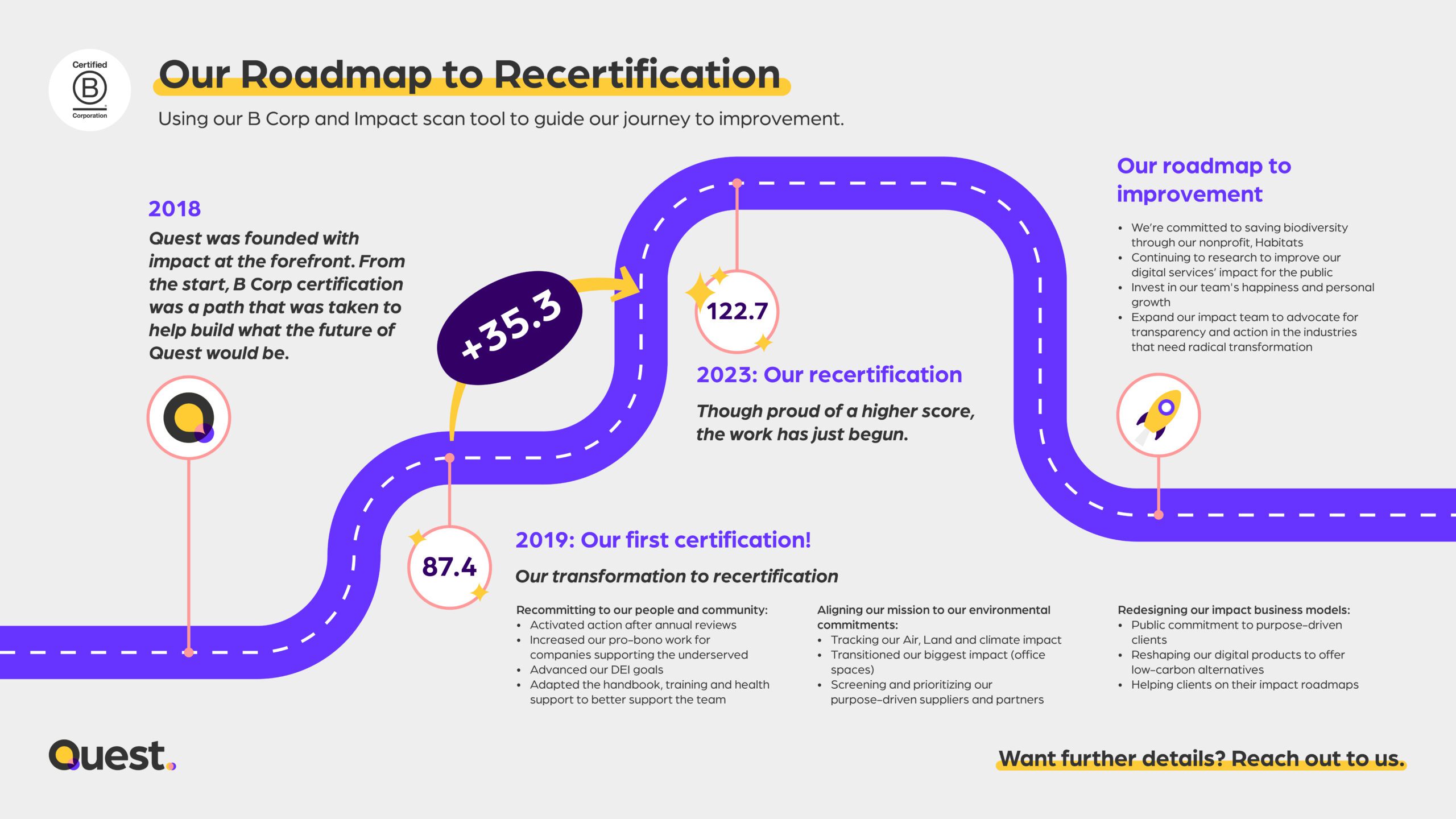
When we first approached the certification in 2019, we earned a certification score of 87.4.

By following the B Impact Assessment, we learned much about our organization’s potential for impact, and ultimately, this framework led to a strong foundation for our future. Yet, as we always say, the certification is only the beginning of this impact journey. 

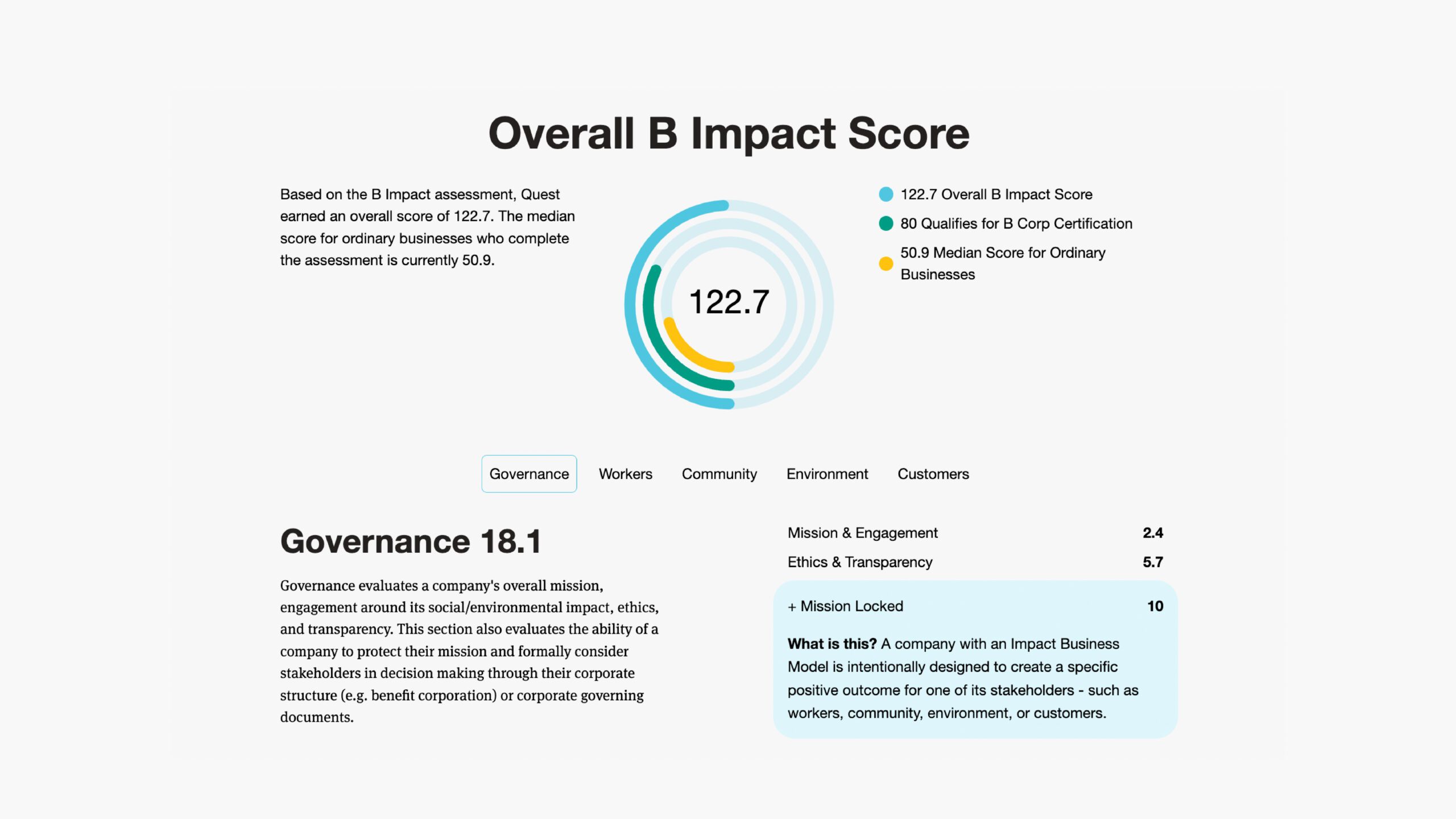
Fast forward to this year, we recertified with a score of 122.7! 

We’re not here to boast about our 35-point increase (although we’re proud). What we truly want to celebrate is the improvement our impact journey led and the lessons we learned along the way.

The Quest Impact Roadmap to B Corp recertification
The Quest Impact Roadmap to recertification

B Corp Recertification Journey

Like our first certification journey, we started auditing our direct and indirect impact alongside our gaps. To do so, we created our own Quest Impact Scan. Inspired by the B Impact Assessment, SDGs, and the GRI framework, we measured and evaluated negative and positive impacts across employees, environment, community, governance, and suppliers to gain insights into areas of strength and areas for improvement.

After measuring our holistic impact, it was time for a materiality assessment to determine the priority areas we could and should further commit to as a team.

These two tools became the input for our Impact Roadmap – full of actionable quick wins and short and long-term impact strategies. Our roadmaps are ever-evolving, constantly adapting to the changing sustainability landscape, and guided by the ultimate aim of fostering a genuine, long-term commitment to sustainability, partnership, and positive impact.

Looking to transform your impact strategy?

Whether you’re starting out measuring your impact, certifying as a B Corp, or ready to start impact reporting, we can help!

Building Impact Business Models

We can write a book of all the steps we took to recertify, instead, we wanted to focus on the power of Impact Business Models (IBMs).

IBMs are one of the three aspects evaluated in the B Impact Assessment, measuring how intertwined social and environmental performance is with the way you do business. Qualifying for an IBM can be challenging, with most certified B Corps having 0-2 IBMs. Earning credit in an IBM is difficult, and having three or more applicable IBMs is extremely rare.

Since day one, our core policy has always been to provide our expertise only to the “right” customers and projects—those who ignite positive change. Why? Impact-driven businesses play a crucial role in transforming business as usual. By partnering with those committed to driving positive impact, we contribute to enhancing and growing the impact space.

Though we were always a mission-locked organization that focused on supporting purpose-driven organizations, we wanted to look at the lifecycle of our organization and our services. Given that we are mainly service-based, we evaluated the negative impact of our only ‘product,’ digital design, and websites. 

Quest's B Corp recertification score

Realizing that about 2% of global greenhouse gas emissions come from the internet every year, we needed to push our digital sustainability efforts. 

With transformation and a lot of learning, we prioritized responsible development to minimize negative impacts and ensure the long-term viability of all our digital design services. It’s not just about reducing the carbon footprint of our digital strategies and products, but also about ensuring accessibility and inclusivity for everyone. This commitment has earned us our third IBM. As they say, good things come in threes, and we couldn’t agree more.

Learn about all the details of our recertification here!

Looking for support in your B Corp journey?

As a certified B Corp and trained B Leaders, we can help you foster an ongoing commitment to sustainability through the B Corp certification and beyond.

The future of our impact roadmap

The B Corp movement is all about driving transformational change. As a certified service provider, we continually ask ourselves: how can we make a bigger impact through our work?

After we finished our original certification, we began conducting extensive research on CO2 neutrality and Net Zero to explore how we could create a tangible impact through our climate-neutral journey

The truth is, for a small company like Quest, obtaining a CO2-neutral label would be a manageable feat. However, we realized that while it might enhance our marketing efforts, it won’t significantly improve our overall impact.

Habitats is a non-profit focused on biodiversity conservation and restoration
Quest Studio's newly launched non-profit Habitats

Instead of using our financial resources for a mere badge of approval, we have decided to invest in what truly matters: saving biodiversity. We proudly partnered and launched Habitats, a non-profit organization dedicated to long-term structural solutions for climate change and biodiversity degradation.

Could Habitats be our ticket to a fourth charitable giving IBM in our 2026 recertification? Probably not. In the meantime, we have been busy leveraging our branding, marketing, and fundraising expertise to make Habitats punch a bit above its weight right from the start.

What we are focusing on is bringing systemic change in the biodiversity conservation and restoration space. Check out Habitats now!

Strategic Positioning in the Age of Greenwashing

As consumers become increasingly aware of the environmental impact of their choices, companies have responded by boasting their green credentials. However, whether intentional or not, not all sustainability claims are genuine. Greenwashing is so prevalent today by acting on this practice, you risk losing all credibility in a blink of an eye. Even companies that do right by their people and the planet are finding this task challenging.


As you navigate this balance, we’ll frame how purpose-driven organizations can strategically position themselves while implementing genuine sustainability practices that build trust, meet legal requirements, and, most importantly, protect the environment.

Strategic Positioning in the Age of Greenwashing

What is strategic positioning?

… and why are we talking about this? 

Strategic positioning refers to a company’s approach in differentiating itself from its competitors. In essence, it’s the question we all ask ourselves – “How am I unique?

For most, positioning is seen as what makes my product different from the others. But a positioning strategy can encompass elements such as branding, customer experience, values, integrity and so much more.

With the greenwash rise, companies must demonstrate their genuine sustainability data to stand out from those jumping on the eco-bandwagon. Yes, its still not too late! By ingraining a sustainability-driven positioning strategy, companies can not only stand out through all the noise but also contribute to a more just and equitable future.

This is all great and good, but what does this look like in practice?

1. Conduct a sustainability audit 

First things first, you have to identify what you are going to measure and track, to then, communicate. Although a sustainability audit may already be in the works in one a department, most do not evaluate overarching impact.  As an example, your organization may be focusing on CO2 instead of mitigation or maybe the percentage of diversity in leadership without evaluating practices of exclusivity in culture.

Need help assessing the current state of sustainability in your company? 

To identify what to measure, start on the Quest Impact Scan. Inspired by the B Impact Assessment, the GRI framework, and the ISO standards, you can use this framework to self-assess and visualize the current state of sustainability in your company.

This first step is time-intensive yet integral to getting it right. Keep in mind, it’s wiser to set up a sustainability audit for your claims than it is to explain your sustainability claims in an audit.

2. Set a tangible sustainability strategy 

Yes, we know you’re here to read about strategic positioning, but setting a tangible sustainability strategy is the foundation to build from.

And a sound sustainability strategy is all about goals and their execution. Now, if we were in business school, we’d say that setting goals should be specific, measurable, achievable, and relevant to your business sector. Now, this is not wrong, but our advice when it comes to the impact strategy is for these goals to be ambitious, met with data, strategic, and interconnected across industries. These sustainability goals should align with all elements of your strategy and, honestly, need to be more ambitious in execution.

If your goals are far-fetched, do you have the data to back them or a strategic action plan to achieve them? For example, every business in our feed has claimed to go carbon-neutral by 2030. Great goal! But what is your transition plan for the energy you are producing in the meantime? If the answer is offsetting, try again.

Additionally, your goals should be all-encompassing. We keep seeing claims to be 50% recycled materials. If your current capabilities are at 35%, then this is a SMART goal. But is there a transition plan for the recyclability of those materials? Where does 50% fit in the purpose and broader business goals on recyclability anyway?

All this is to say that incorporating sustainability goals into the company core can position your company as a leader in your industry, building a strong reputation and competitive advantages that can be beneficial in the long term instead of the two-second internet celebration.

Need help aligning business efficiency and profitability?

We help you create a more positive impact faster with an impact strategy that perfectly balances purpose with profit and strengthens your image. Based on the sustainability audit insights, with Quest Impact Accelerator we co-create an actionable impact strategy tailor-made to your company’s needs while upholding your bottom line.

3. Be transparent

Want to have a strong positioning strategy? Be transparent. And yes, this means the downfalls too. Being transparent is your time to earn credibility for all the work put forth. Openly sharing your sustainability practices, goals, and progress shows stakeholders the honest commitment to reducing environmental impacts and creating a more sustainable future.

Now, this brings a lot of uncertainty to businesses that have risk-averse investors, but it is proven that communicating sustainability practices does a lot more for organizations than posting about their ambitions.

In 2021, B Corp-certified eyewear company Ace & Tate issued a humbling press release, “Look, we f*cked up,” addressing mistakes made around sustainability and its efforts to change.

This radical transparency has been proven to be effective in building trust with stakeholders by providing them with all the information they need to make informed decisions.

How effective is it? On Instagram alone, Ace & Tate’s post disclosing these shortcomings boasted higher engagement than the preceding B-Corp Certification announcement the day before—representing +450% higher engagement than the average post for the trailing 30 days.

Yet, doing this efficiently is easier said than done. Start with your framework to report this. Select your themes to explain your action plan, share ALL progress updates (or lack thereof), and always include an avenue for feedback.

As impact marketers, we can assure you that standard content creation that celebrates wins is no longer enough to impact the bottom line. People and businesses want genuineness; meet them where they are.

Does your brand need help standing out?

At Quest Studio, we are on a mission to help scale and accelerate impact-driven businesses, and we truly believe SEO is crucial to standing out in this overcrowded market tainted by greenwashing.

4. Partner with others

Many companies share the common sentiment that they’re too small to influence their entire value chain.

Yet, many treat partnerships as a growth-only opportunity where industry or cross-industry partnerships could lead to sustainable transformations and, in turn, a stronger position in the market.

By collaborating with others, you can leverage your business strengths, pool resources, and share knowledge to achieve common goals that may be difficult to achieve alone Diana Garcia, Quest’s Head of Growth

This can lead to increased efficiency, reduced costs, and improved innovation, all of which can help you stand out in your sector. Additionally, through partnerships, you can gain access to new markets, technologies, and expertise, which can help you expand your company’s offerings and reach new customers.

Take ice cream brand Ben & Jerry’s and chocolate manufacturer Tony’s Chocolonely, for example. United by a shared passion for social justice, their latest partnership is taking both companies’ sustainability journeys to the next level. By adopting Tony’s 5 Sourcing Principles, Unilever-owned Ben & Jerry’s is pulling its weight in the effort to ensure a fully traceable cocoa supply chain while addressing poverty, the root cause of social injustice for cocoa farmers.

Now, what does this have to do with positioning? Consumers are looking for those leading the way in terms of sustainability, and by having a partnership approach, you can reach and communicate the transformation faster than doing it alone. From a B2B perspective, organizations are looking for those open to collaboration and sharing resources for an even faster industry transformation. Being a leader in this collective action is always a great position to be in, no matter your growth goals.

5. Verify

The do-it-yourself sustainability evaluation is no longer credible or viable. Collaborating with credible third-party organizations can help verify your sustainability efforts and help you strategically position your company as a sustainable business. These evaluations can include sustainability audits, certifications, or nonprofit-led movements, such as B Corp Certification.

Now, this would not be true to our values if we just said, “Verify and be done with it.” Organizations should have third-party audits to prove their work, but that is not the end of the story.

Assessments, certifications, and frameworks should not be a checklist item, but a learning exercise to act and improve.

Take the example of fellow B Corp Willicroft. After conducting an initial Life Cycle Assessment (LCA), the plant-based cheese company found their core ingredient, cashew, to be highly emitting and highly water consuming – Willicroft’s cashew-based Italian Aged was only 2.5 times less emitting than dairy Parmesan. Ultimately, the Amsterdam-based company switched to white beans as its core ingredient, as it would lead to major emissions reduction and can be grown locally.

We strongly believe that this is only the beginning of the endless ripples of change to come.

Ready to start your sustainable positioning strategy?

Convinced in what you see and ready to scale your purpose-driven organization. Let’s connect with our free hour consultation to help.

The power of customer journey optimization

Consumers today are more sustainability-conscious than ever before, and they demand that the brands they buy from follow suit. With the rise of the conscious customer, the world is finally discovering that businesses prioritizing sustainability have a unique value proposition. By optimizing their customer journey, sustainability-driven businesses can meet the needs of responsible customers and gain a competitive edge in attracting and retaining them.

Visualization of Customer Journey Optimization

The Rise of the conscious customer

According to Deloitte’s latest consumer behavior survey, consumers are proactively pursuing a sustainable lifestyle by purchasing from brands with ethical or environmental procedures or avoiding those with concerning practices altogether. Additionally, a survey conducted by Accenture revealed that 62% of consumers worldwide want companies to actively address pressing issues such as sustainability, transparency, and fair employment practices. Meanwhile, according to Nielsen, 81% of global consumers feel strongly that companies should help improve the environment.

You think you own your business, but you don’t. Customers do

And with the rise of sustainability-conscious consumers, it’s more important than ever for brands to meet these new expectations. They want to know that the brands they support are doing their part to protect the planet. Impact-driven businesses should leverage this trend by prioritizing sustainability in their brand strategy and providing customers with an optimized customer journey that meets their evolving needs and expectations. Only by doing so can they meet the sustainability expectations of their clients and transform them into successful long-term profitability.

Can conscious customers drive industry change?

Consumer insights show a growing awareness of the negative environmental impact of their purchases, and brands are beginning to respond. Discover how understanding your audience can lead to innovation and growth.

Understanding the Customer Journey

The customer journey refers to the entire lifecycle of interactions and experiences a customer has with a business. It encompasses every touchpoint, both online and offline, that a customer encounters while interacting with a brand. These touchpoints can include advertisements, social media interactions, website visits, customer service interactions, and more. The customer journey can be broken down into four stages:

  • Awareness: At this stage, the customer becomes aware of your brand and what you have to offer. This can happen through marketing efforts like social media ads or word-of-mouth recommendations from friends and family.
  • Consideration: Once a customer is aware of your brand, they start considering whether or not they want to engage with it further. This might involve researching your products or services, reading reviews, or comparing prices with competitors.
  • Decision: If a customer decides to purchase your brand, this is the decision stage. At this point, the customer is weighing the benefits of your product or service against the cost.
  • Retention: Finally, the retention stage refers to the ongoing relationship between the customer and the brand. This could include repeat purchases, leaving reviews, or recommending the brand to others.

Customer Journey map

Customer journey mapping is a vital tool for businesses aiming to optimize their customer experience. It visualizes and understands the customer’s interactions, emotions, and touchpoints from awareness to purchase and beyond. By gaining insights into the customer’s experience, their needs, expectations, and behaviors at each touchpoint, businesses can identify pain points and discover opportunities for improvement.

For impact-driven businesses, customer journey mapping is crucial for aligning touchpoints with sustainability goals. It encourages collaboration among departments like marketing, sales, and customer service to deliver a sustainable and impactful customer experience. It’s an ongoing process of improvement, allowing businesses to stay agile and responsive to evolving sustainability trends. Whether it’s highlighting eco-friendly product features, showcasing responsible manufacturing processes, or offering sustainable packaging options, customer journey mapping ensures that sustainability is seamlessly integrated into every step of the customer’s interaction with the brand.

Benefits of an optimized customer journey

Optimizing your customer journey always benefits businesses; it can increase customer satisfaction, conversion, and the ability to create a competitive advantage in an ever-evolving customer-driven marketplace. 

  1. Stronger Customer Satisfaction
    By providing an optimized experience, businesses can create a positive experience that leaves customers satisfied and valued.
  2. Improving brand reputation and customer loyalty
    By prioritizing sustainability, businesses can build a reputation as impact-driven brands that care about their customers’ future. This can lead to increased customer loyalty and advocacy, as customers are more likely to stay loyal to a brand that aligns with their values.
  3. Increasing Conversion Rates
    By creating a seamless experience for customers, businesses can remove potential barriers to purchase and make it easier for customers to complete transactions. This optimized process can lead to increased conversion rates and, consequently, higher revenue.
  4. Fostering Innovation
    By understanding customer needs and pain points, businesses can uncover innovation opportunities. This understanding allows them to develop new and improved products, services, or processes that directly address customer challenges and enhance their overall experience. This commitment to innovation enhances the customer journey and allows businesses to stay relevant, adapt to evolving market trends, and sustain long-term success.
  5. Competitive Advantage
    By providing an optimized customer experience, sustainable businesses can differentiate themselves and create a competitive advantage. In this customer-driven marketplace businesses prioritizing customers are more likely to stand out from the competition and succeed in the long term.
  6. Improving Sustainability
    Finally, by focusing on the most effective channels and touchpoints, businesses can reduce waste and create a more impactful business model and strategy. This can help reduce their impact and contribute to greater sustainability for businesses, the planet, and its people.

Customer Journey at Quest Studio

At Quest Impact Design Studio, we aim to optimize your customer satisfaction and retention rate by taking your customer experience to a higher level.

How do we do it?

Market & competitor research: We analyze your industry, including your competition, to provide key insights, relevant case studies, business models, applicable frameworks, and inspiration with diverse applications. We conduct comprehensive interviews with employees to capture the full scope of your organizational activities and identify needs and opportunities related to sustainability and CX.

Inside-out journey: We develop inside-out customer journey maps for each customer segment, including a digital and adaptable version. Through this collaborative process, we ensure a comprehensive understanding of the customer experience and facilitate the creation of a robust CJM.

Stakeholder interviews: We interview relevant stakeholders to understand how they perceive you in the industry, comprehend their actions, frustrations, and delights, and identify gaps, pains, and gains in their customer journey. We align this insight with what customers prioritize when it comes to sustainability.

Why did we start a non-profit focused on biodiversity conservation and restoration?

I guess we could make this our shortest blog post ever and give the most straightforward answer: because it’s obviously very necessary. That wouldn’t be very good for our SEO, though, and I’d also like to explain how we came up with the idea to start our non-profit organization focused on biodiversity conservation and restoration.

Habitats is a non-profit focused on biodiversity conservation and restoration

Our CO2-neutral journey

We have already written a lengthy blog on why we decided not to focus on CO2 neutrality, so I’ll give you the summary:

Everyone knows we are selective of the customers we work with. And the customers we work with know that we always try to push them further in their positive impact. It sounds good, but for us, that also means we have to walk the talk.

That’s why we conducted extensive research on CO2 neutrality and Net Zero, also pushed by the B Corp Climate Collective. The reality is: for a small company like Quest Studio, it would be rather easy to obtain a CO2-neutral label:

Step 1: Hire a CO2 expert and provide them with all the required data

Step 2: Analyze the insights and define reduction goals (although, at times, this step seems to get skipped)

Step 3: Choose a project to compensate for the current emissions

Step 4: Market your carbon neutrality

Step 5: Repeat annually

The total cost for Quest would probably be around 6,500 EUR per year. Well, instead of obtaining a label that many companies are still using as an excuse to ignore their carbon footprint, we would prefer to increase our impact by directly investing those 6,500 EUR in something we believe in. Enter Habitats.

Habitats logo

Check out our newly launched non-profit Habitats!

Founding partners with a similar vision on conservation and restoration

When I discussed this dilemma with my friend Ellis, she introduced me to David ‘Billy’ Herman. Billy is the founder of Starling Travel, a travel agency that focuses on nature tours. Billy shared similar ideas about the need to prioritize biodiversity. After a few discussions, we joined forces to start a non-profit organization focused on biodiversity conservation and restoration together. The main ideas:

  • There’s so much focus on restoration because it’s easier to market. Preserving what we have also deserves more attention. We urgently need more of both.
  • We want to establish a clear link between climate change and biodiversity.
  • Looking at that link, there’s too much attention going to planting trees because – again – it’s the easiest to market. While definitely needed, there are also other interesting habitats with huge CO2-sequestration potential that are immensely undervalued. Did you know that increasing phytoplankton productivity by only 1% would have the same effect as the sudden appearance of 2 billion mature trees?
  • Local communities are integral in making conservation and restoration projects work in the long term.

Then, we crossed paths with Lien De Ruyck, a positive impact warrior who’s been a friend of Quest for quite some time now. In the last few years, Lien has undertaken many trips, including to Antarctica, to make the science of conservation and restoration more accessible through storytelling. Upon meeting, we immediately knew it was a match, so Lien joined our founding team.

Quest team’s passion for biodiversity

Starting our non-profit organization is a big step that inevitably leads to a lot of internal discussions. As you would expect from truly impact-driven professionals, all Quest team members are huge nature lovers and were immediately supportive and excited about the idea. It’s just great to see the dedication they put into Habitats, especially when they are working on the branding or website.

Was a new non-profit organization really necessary?

You could say yes and no, but I’m definitely going to say yes. No, because there are already many good organizations focusing on biodiversity conservation and restoration out there. Yes, because we need way more of them, and we also think we can add value to the conversation. 

Habitats is led by a very diverse team of biologists, biodiversity experts, marketers, strategists, researchers, and nature photographers passionate about biodiversity. As an interdisciplinary team, we have the power to look at things from a different, less typical angle.

We want to use the service and business design expertise of Quest Studio to keep looking at things from a more holistic/systemic point of view. To focus on the root causes of problems and not just fight the symptoms.

At Quest, we’re also used to making hard decisions when it comes to selecting customers. Decisions that negatively affect your profit in the short term, but exponentially increase your positive impact in the long run. We want to take that experience to Habitats as well. All our projects will be very carefully selected, and we won’t always choose the usual suspects. It will be our job to make the less usual suspects equally sexy to donate to.

In addition, we see a lot of non-profit organizations with solid vision struggle to get funds because they can’t afford to invest in marketing. Well, Quest just happens to be an expert in branding, marketing, and fundraising tactics, which allows Habitats to punch a little bit above our weight right from the start.

How are Habitats and Quest linked to each other?

First of all, Quest is a founding partner of Habitats, together with Starling Travel and Lien De Ruyck. Quest was also appointed Chairman of the Board of Directors of Habitats. Together with the other board members and founders, we will devise the strategy for the next few years and oversee its execution.

We have also taken on a leading role in a world we know best. We took charge of the branding, positioning, and website (UX/UI, copy, and development) of Habitats. Together with Lien, we’ll also be responsible for the management of all social media and communication channels of Habitats.

Habitats logo

There is so much to share about Habitats  

It was truly demanding, yet exciting, to witness our vision come to life. Want to know more about Habitats’ digital journey? Explore the creation of Habitats’ branding and website.

Can consumer insights drive industry change?

The current state of sustainability in the fashion industry can be described as a global environmental and social emergency. The industry has destructive effects on the planet and people: it releases greenhouse gases into the atmosphere, drains vast amounts of water and energy, and is responsible for human rights violations when it comes to labor rights.


On the one hand, consumer insights show a growing awareness of the industry’s impact and the need for change. On the other, many brands still prioritize profit over sustainability, and the production and disposal of fast fashion continue to harm the environment and exploit workers. Luckily, there is a growing movement of consumers who are demanding more sustainable options, and brands are beginning to respond.

Industry change in Action

As consumers have become more aware of the environmental impact of the fashion industry, many fashion brands have started to prioritize sustainability in their operations. Consumer insights have played a key role in this shift, as brands have used data on consumer preferences and behaviors to inform their sustainability strategies.

Levi Strauss & Co. has used consumer insights to identify which sustainable materials and production methods are most appealing to its customers and to guide its sustainability strategy more broadly. Already in 2011, Levi Strauss & Co. launched its Water<Less® program in response to consumer concerns about the amount of water used in the production of denim, particularly in water-scarce regions. More recently, Levi’s has used data on consumer demand for sustainable products to guide its product development, launching Recycled 501. The new denim line is a sustainable version of Levi’s most iconic product, the 501 Original, and speaks to both the enduring nature of the 501 and the brand’s commitment to moving towards more circular products and practices.

Luxury brand Eileen Fisher has been a leader in sustainable fashion for many years and has been vocal about the importance of using data to drive change in the industry. Making use of data on consumer demand for sustainable materials and production methods, the clothing brand has launched several sustainable initiatives based on consumer insights. Eileen Fisher’s “Renew” program allows customers to bring in used Eileen Fisher clothing and accessories to be resold or upcycled. By advancing a circular business model grounded in both community involvement and human rights empowerment, the brand successfully certified as a B Corporation in 2020.

Interested in certifying as a B Corporation? 

As the certification becomes more popular globally, many companies are looking into becoming B Corps. Let us tackle the most frequently asked questions surrounding B Corp certification.

Consumer insights vs Consumer behavior

Although consumers are said to be increasingly concerned about unethical conduct in the industry, this attitude does not always translate to a change in consumer behavior. Money.co.uk revealed in a recent report that Shein is 2022’s most popular fashion brand. The ultra-fast fashion company that admitted breaches of China’s labor laws is also revealed to be Google’s most-searched brand in 113 countries, overtaking other retail giants in the industry. Meanwhile, the Zalando Attitude-Behavior Gap Report highlights that, while nearly three in five fashion consumers recognize that they carry individual responsibility for their fashion choices, one in two consumers is not even certain what sustainability means to fashion. Indeed, just 38% of respondents said they bought fashion based on the sustainability of production processes, and only 23% said they did so because of the brand’s labor policy.

There appears to be a significant gap between consumer beliefs and their actions when it comes to fast fashion. This may be due to conditioning from being born into a system where fast fashion businesses thrive, leading individuals to believe that clothes should be cheap and encouraging fast-paced purchasing. Adjusting perceptions about the value of clothes, finding shopping alternatives, and changing consumption habits can take time. Moreover, in more developed countries, the harmful impact of fast fashion may not be an everyday reality. Consequently, considerations of the environmental and labor impact of clothing may not be readily apparent when shopping or clearing out wardrobes. 

By understanding consumer behaviors, values, and beliefs, brands can cater to customer needs creating more sustainable products that appeal to a growing audience of sustainability-conscious consumers, but be careful not to fall into the greenwashing trap!

Researches also show that there is a common desire among consumers for more guidance on sustainability issues. According to Zalando’s It Takes Two, around 52% of consumers believe it is important to have someone to show them how to be more sustainable. By guiding through sustainability issues, brands can help their customers make more informed and sustainable choices, while also building trust and loyalty with their customer base.

Does your brand need help standing out?

We can help you involve and educate your customers on your sustainability practices and initiatives, optimize your online presence, and reach a wider audience with a customized and impact-driven SEO content strategy.